

MicroDens
Density and concentration, where you need it
For laboratories and production departments in wineries, breweries, distilleries and the food industry. The instrument stores Food & Beverage package methods and up to 20 user methods.
Key features
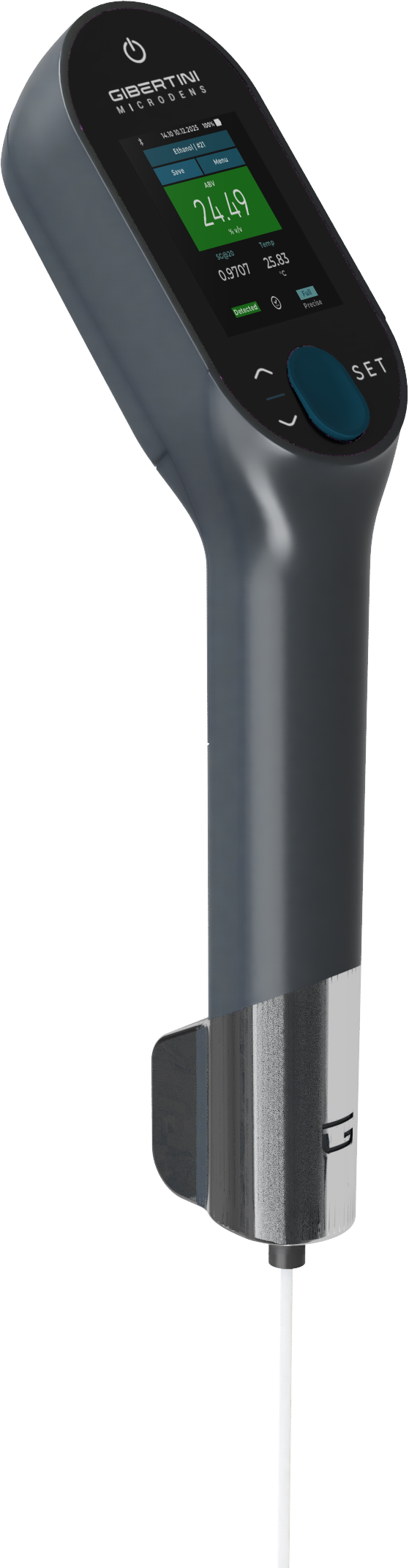
MicroDens is a portable digital density meter. It measures density and concentration in the laboratory and on site, with an accuracy of ±0.0001 g/cm³.
MEMS measuring cell
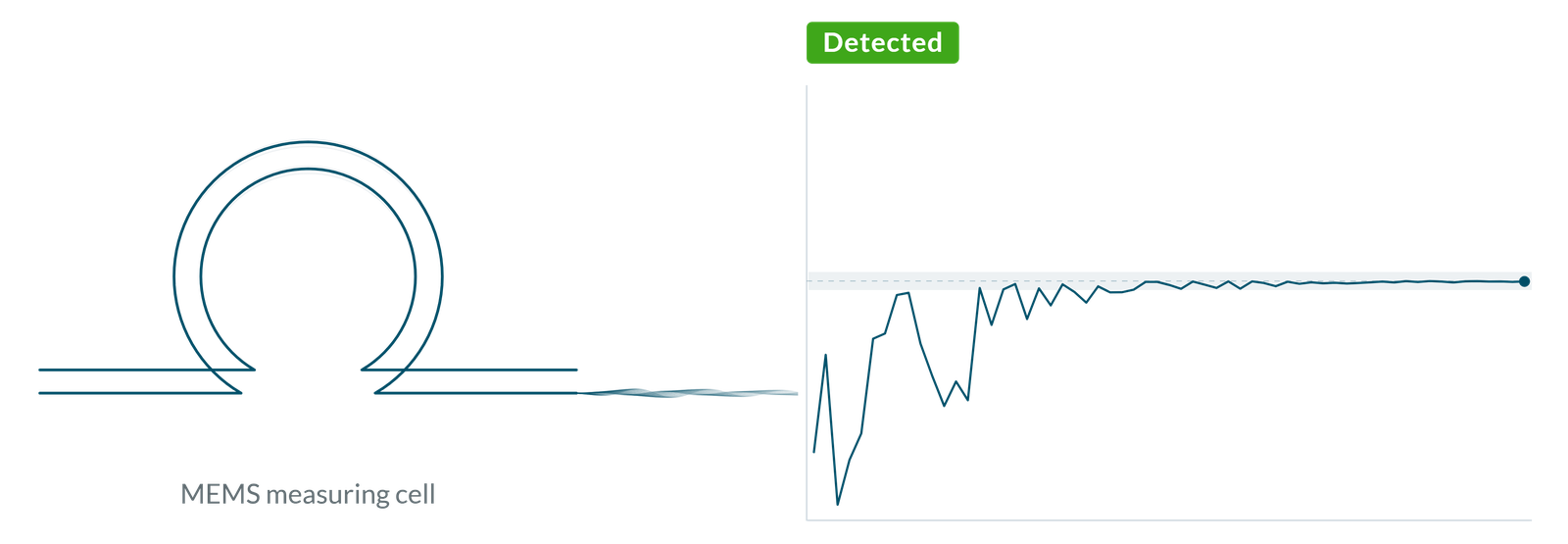
The sample fills an omega-shaped silicon microchannel that oscillates in a vacuum. The oscillation frequency changes with the density of the sample.
±0.0001 g/cm³Predefined methods
Methods for wine and must, beer, spirits, food and beverages, in the Food & Beverage package. Each method sets the displayed quantities, the reference temperature and the temperature compensation.
Food & Beverage + 20 userUse on site
380 g with battery pack and filling tube. The 2500 mAh battery lasts 10 hours of continuous use and is charged through the USB-C connector.
380 gMemory and connections
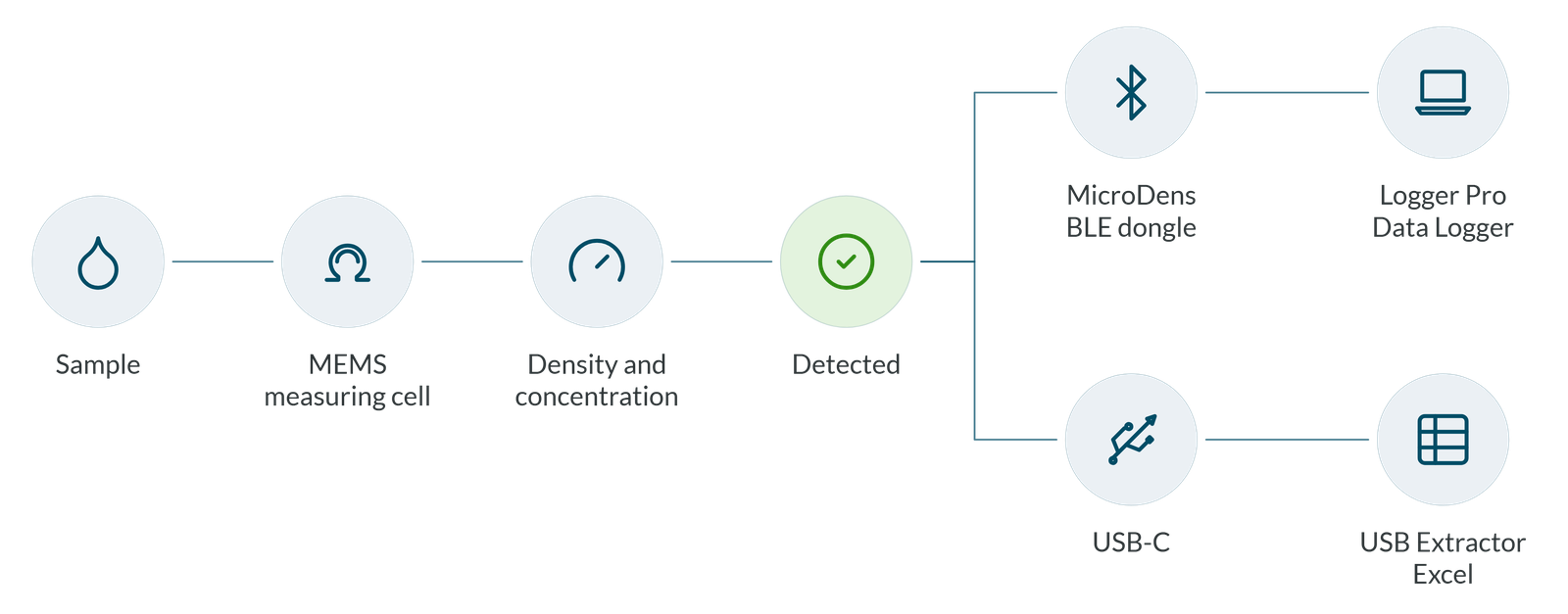
The memory holds 2000 measurements with date and time. Measurements are sent to the PC over Bluetooth, through the MicroDens BLE dongle, or downloaded with the USB-C cable.
2000 measurementsMeasuring principle
The measuring cell is a silicon MEMS sensor with an oscillating tube: the oscillation frequency of the microchannel changes with the density of the sample. The temperature sensor built into the cell provides automatic temperature compensation; results are referred to 20 °C.
Sample detection
SmartStabilizer detects the sample automatically. It compares the readings of successive fillings and distinguishes the sample from a transient phase, such as cleaning of the cell or a sample change. When successive fillings agree, the display shows “Detected” and the reading is stable. There is no need to judge by eye when the reading is valid.
Measuring procedure
Methods and sample ID
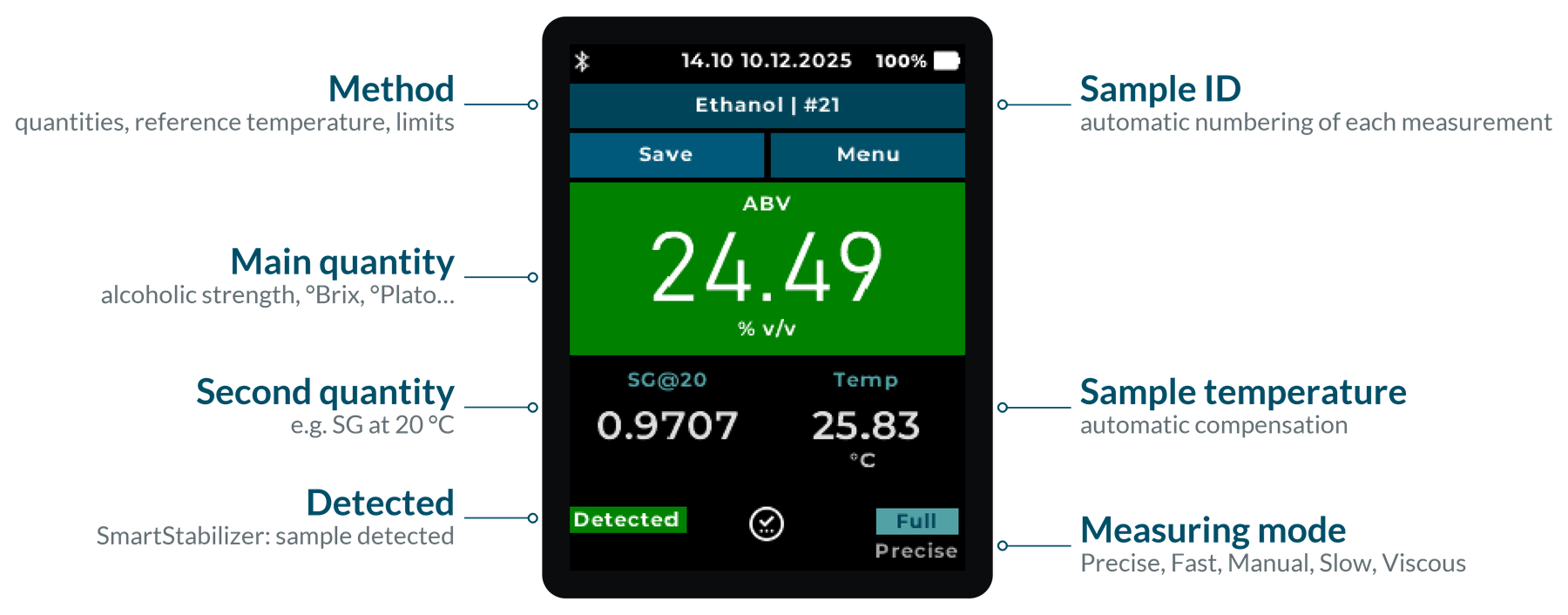
The method determines what the display shows; the sample ID follows each measurement through to the PC.
Food & Beverage methods
The Food & Beverage package includes methods for wine and must, beer, spirits, food and beverages. Each method sets the displayed quantities, the reference temperature and the control limits.
User methods
Up to 20 user methods, created from scratch or from a predefined method, which remains unchanged. Settings include two quantities, the reference temperature, the temperature coefficient, the measuring mode and the limits.
Sample ID
The instrument stores up to 35 sample IDs, including automatic numbering (WINE-001, WINE-002…). The ID follows the measurement into Excel files and MicroDens Logger Pro.
Method settings and ID rules are described in the user manual: Downloads and documents
Application sectors
Predefined methods for the food, brewing, wine and spirits industries
Control limits
Each method sets the minimum and maximum limits of the main parameter. The display background is green for a stable measurement within limits and red for a measurement out of limits.
- Limits set in the method
- Result shown by the background color
- Measurement status included in exported files
A change in density indicates a change in composition, through dilution, contamination or adulteration: the measurement verifies that the product matches what is expected, from the receipt of raw materials to shipment.
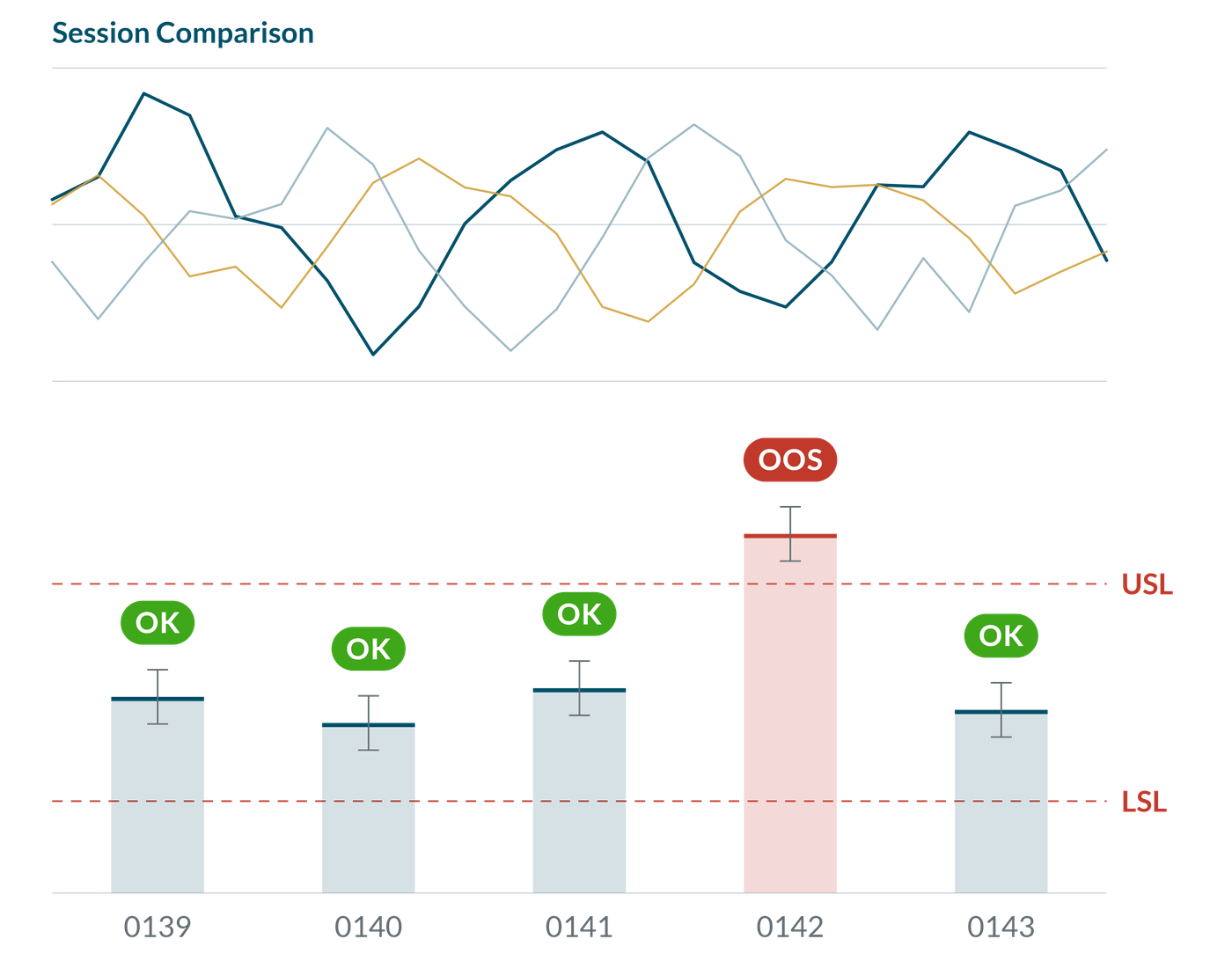
Batch comparison in MicroDens Logger Pro, with the upper and lower limits: within limits and out of limits.
PC software
Three free programs and one paid program, for Windows 10 and 11.
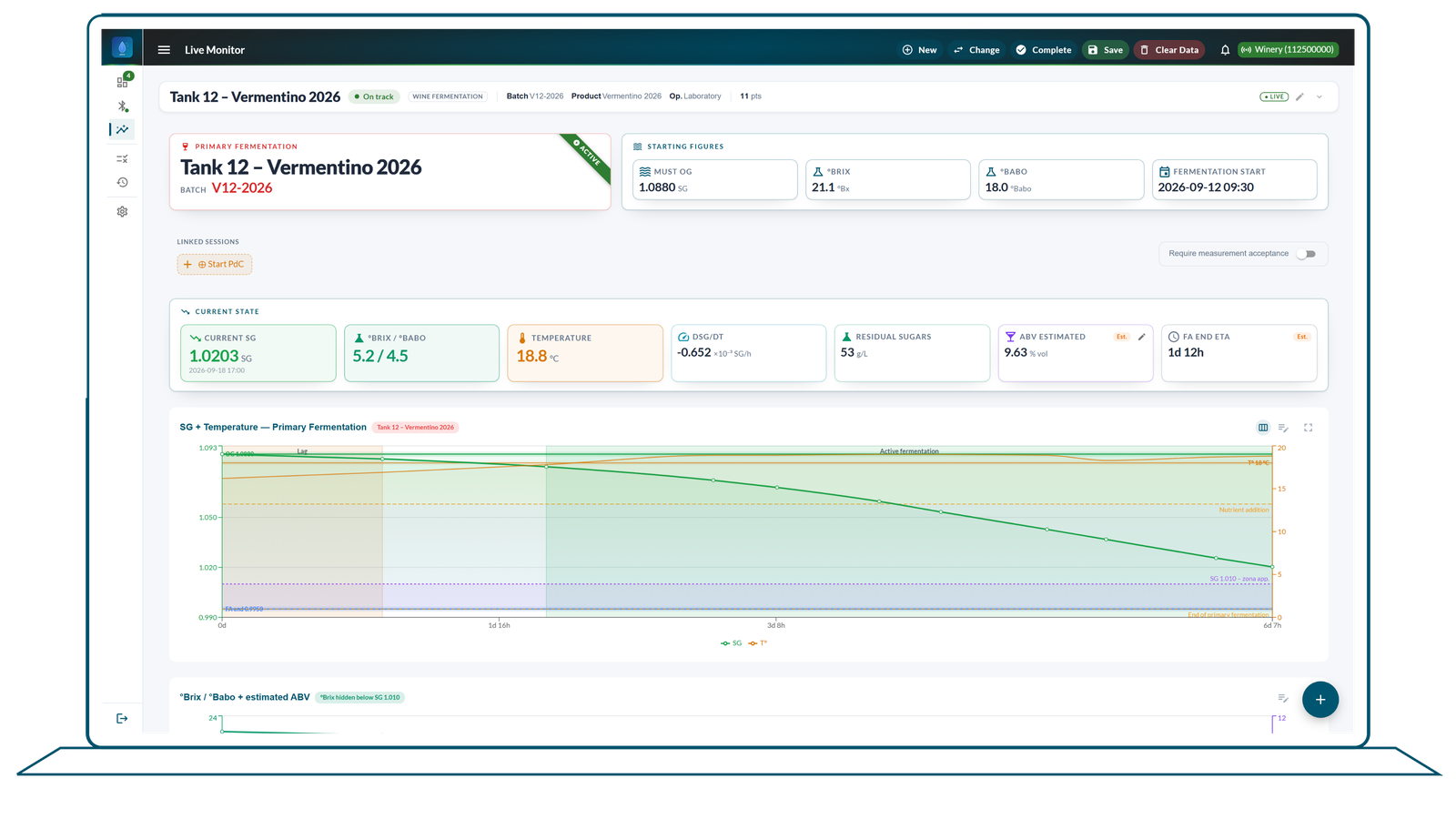
MicroDens Logger Pro, Fermentation module. Demonstration data.
Quick guide, user manual, technical sheet and programs on the Downloads and documents page
Open Downloads and documents Download the brochureTechnical specifications
Data from the MicroDens technical sheet
| General features | |
|---|---|
| Display | 2.8" color touch display |
| Keyboard | UP, DOWN and SET touch keys; PUSH, the only physical key, draws in and expels the sample |
| Battery | Li-Pol battery pack, 3.7 V, 2500 mAh |
| Battery life | 10 hours of continuous use, 100 hours on standby |
| Dimensions (L × W × H) | 320 mm × 100 mm × 65 mm |
| Weight | 380 g (battery pack and filling tube included) |
| Seals | Viton |
| Operating conditions | Ambient temperature 0…+40 °C; relative humidity 5–90 %, non-condensing |
| CE conformity | Directives 2014/30/EU, 2014/35/EU, 2014/53/EU and 2011/65/EU (RoHS) |
| MEMS measuring cell | |
|---|---|
| Density, range | 0.600…1.200 g/cm³ |
| Density, accuracy | ±0.0001 g/cm³ |
| Density, repeatability (s.d.) | 0.00005 g/cm³ |
| Density, resolution | 0.00001 g/cm³ |
| Sample temperature | -10…+60 °C |
| Temperature, accuracy and resolution | ±0.1 °C; 0.01 °C |
| Viscosity | Up to 50 mPa·s, calibrated up to 5 mPa·s |
| Sample volume | 1 mL per filling; 3 to 5 fillings for the “Detected” result, depending on the liquid |
| Measurement modes | 5: Precise, Fast, Manual, Slow, Viscous |
| Methods and memory | |
|---|---|
| Methods | Food & Beverage package and up to 20 user methods |
| Wine and beer | Wine DryExt (OIV or Hackbarth), Wine Must, Beer DryExt, BeerQuick, QuickPlato |
| Alcoholic strength | % v/v, % w/w, US Proof (at 60 °F) |
| Sugar tables | °Brix, °Plato, °Babo/KMW, °Baumé, °Oechsle |
| Binary solutions | Sucrose, glucose, fructose, glycerol, propylene glycol, NaCl |
| Memory | 2000 measurements |
| Adjustment history | Last 30 adjustments |
| Other functions | SmartStabilizer (automatic sample detection), control limits, menu PIN protection |
| Connections and data | |
|---|---|
| Interfaces | USB-C, Bluetooth |
| MicroDens BLE dongle | Bluetooth connection to the PC; included |
| Printer | Bluetooth thermal printer supplied by Gibertini |
| PC software | MicroDens Data Logger, MicroDens USB Extractor, MicroDens Script Runner (free); MicroDens Logger Pro (paid) |
| Languages | Italian, English, German, French, Spanish |
| Sample ID | Up to 35 IDs of 19 characters, up to 20 of them with a counter |
| Calculation references | |
|---|---|
| Measuring principle | Electronic densimetry with an oscillating tube, based on the principle of method B of OIV-MA-AS2-01 (density and specific gravity at 20 °C) and OIV-MA-AS312-01 (alcoholic strength by volume) |
| Alcoholic strength | Calculated from density with the OIML R 22 International Alcoholometric Tables, as required by OIV-MA-BS-01 and Commission Regulation (EC) No 2870/2000; identical at 20 °C to OIV-MA-AS312-02, Table I |
| Strength at 60 °F (US) | US Proof, % vol at 60 °F and SG 60/60 °F, calculated on the basis of the AOAC/TTB tables (27 CFR 30.66, Table 6) |
| Total dry extract | Calculated according to OIV-MA-AS2-03B |
| Water density | Tanaka et al. (2001), Metrologia 38 |
| CE marking | |
|---|---|
| 2014/30/EU | Electromagnetic compatibility |
| 2014/35/EU | Low voltage |
| 2014/53/EU | Radio equipment |
| 2011/65/EU | RoHS |
| Applied standards | EN IEC 61326-1:2021, EN IEC 61326-2-3:2021, EN IEC 61010-1:2013, ETSI EN 301 489-1 V2.2.3, ETSI EN 301 489-17 V3.3.1 |
Calculation of total dry extract
Wine DryExt method
Demonstration on customer samples
Gibertini arranges MicroDens demonstrations on samples from the laboratory or production.
Information and quotations: info@gibertini.com, +39 02 3541434.