Food Industry
MicroDens for

Quality Control
Food & Beverage

MicroDens is the portable density meter for analysis of density, Brix, NaCl and concentration in food solutions, with the same precision as benchtop instruments but in a compact format. Ideal for production line controls, goods-receiving checks and laboratory validations, it ensures traceable results compliant with international standards AOAC, ISO, ICUMSA and Codex Alimentarius.

0.00001 g/cm³ Resolution
±0.0001 g/cm³ Accuracy
Multiparameter Brix, Density, NaCl, Baumé, Fructose
HACCP Ready Traceability & Cleaning
Made in Italy 🇮🇹
Discover more

Measurement Principle

Oscillating-tube MEMS sensor, automatic temperature compensation, calculation of Brix, NaCl, density and concentration according to international food tables and standards (AOAC, ICUMSA, Codex Alimentarius).

Density & Concentration

Sugars, Salts, Extracts

MicroDens enables the determination of density, Brix, NaCl, Baumé and Fructose in low-viscosity aqueous food solutions. Ideal for fruit juices, brines, beverages, milk and dairy products, liquid preserves and diluted sugar solutions (η ≤ 5 mPa·s).

Reference Standards
AOAC 932.14 – Soluble solids in fruit and derivatives
ISO 2173 – Soluble solids in fruit and vegetable products
ICUMSA GS2/3-1 – Refractometric dry substance
Codex Alimentarius STAN 212-1999 – Sugars and concentrated solutions standard
  • °Brix – Juices, beverages, light syrups (Brix ≤ 35)
  • Density – Diluted emulsions, aqueous concentrates, milk
  • NaCl – Brines, preserves, covering liquids
  • Baumé – Medium-concentration syrups
  • Fructose – Diluted solutions (η ≤ 5 mPa·s)
  • Accuracy ±0.0001 g/cm³ | ±0.1 °Brix
  • Resolution 0.00001 g/cm³ | 0.01 °Brix
Instrument limit: samples with η > 5 mPa·s (oils, honey, concentrated syrups, purées) are outside the stated specification and cannot be measured with the indicated accuracy.
AOAC ISO ICUMSA Codex Alimentarius

How to use MicroDens

A simple operating protocol, in line with food quality systems (HACCP, BRC, IFS, ISO 22000):

1

Raw material receiving

Check of Brix, density or salinity on arrival of juices, beverages, brines and aqueous solutions.

2

Formulation preparation

Adjustment of concentrations during mixing to ensure sensory and production consistency.

3

Process control

In-line or at-line check of density, dilution and temperature at critical stages such as concentration or pasteurization.

4

Finished product

Final analysis on the packaged batch to verify label specifications and uniformity.

5

Shelf-life and maintenance

Periodic monitoring of samples to assess stability, sedimentation or changes in consistency.
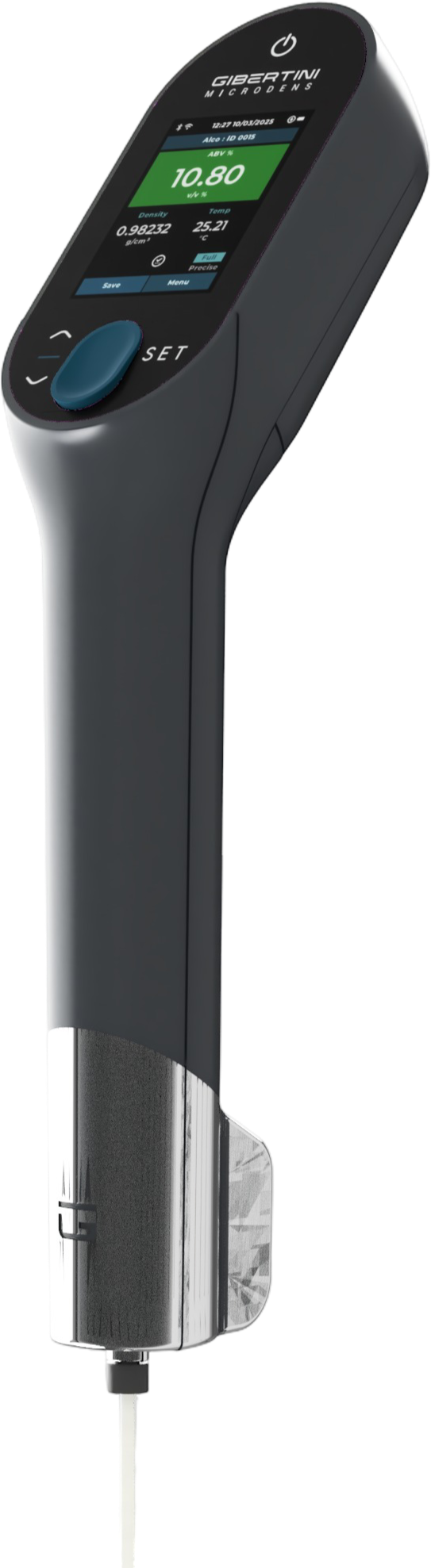
MicroDens Food

Available Parameters

All the key values for food quality control, with certified accuracy and resolution.

Output Parameters
Density (ρ)0.6–1.2 g/cm³
°Brix (Sugars)0-35 °Bx
NaCl0–26 % w/w
Baumé0–30 °Bé
Fructose0–35 %
Temperature reference20 °C standard
Metrological Performance
Parameter Accuracy Resolution
Density (ρ)±0.0001 g/cm³0.00001 g/cm³
°Brix±0.10 °0.01 °
NaCl±0.10 %0.01 %
Temperature±0.2 °C0.1 °C
Sample viscosity (max)≤ 5 mPa·sstated spec.

Milk Control

Process monitoring and rapid screening in the dairy sector

Milk quality control

DM 9/5/1991 n. 185 • CE 853/2004 • CE 273/2008 • EU 605/2010

MicroDens offers rapid and continuous monitoring of the density of milk and its derivatives, with immediate practical value for process management in the dairy and on the farm.
Density at 15 °C is a useful parameter for daily operational control, but does not replace the cryoscope for legal checks against fraud.

Reference regulations
DM 9/5/1991 n. 185CE 853/2004CE 273/2008EU 605/2010
  • Standardization and process monitoring
  • Verification of powdered milk reconstitution and substitutes
  • Density of residual whey (ricotta, reverse osmosis, concentration)
  • Rapid in-house screening: first internal warning signal

Reference values (SG 15 °C)

Regulatory density by species

Species Regulatory Range (g/cm³) Reference
Cow's milk1.029 – 1.034DM 185/1991
Buffalo1.029 – 1.033Regional Law
Goat1.033 – 1.039RD 9/5/1929
Sheep1.035 – 1.040Regional regulations
MicroDens milk process control

How MicroDens supports process control

1. Sample collection
Before measurement, the instrument should be rinsed with 3-4 rinse cycles of ~1 mL each to condition the cell. The whole process requires about 10 mL of sample, ensuring an accurate and repeatable result.
2. Automatic measurement
Density measured with automatic thermal compensation.
3. SG 15 °C
Automatic conversion to SG 15 °C according to regulations.
4. Comparison with SG ranges
Comparison with species ranges (DM 185/1991) as an internal operational reference — not for legal purposes.
5. Rapid alarm signal
If the density is abnormal, the operator blocks the tank and sends the sample for official cryoscopic analysis.
Guaranteed Compliance

Regulations and Standards

MicroDens operates in compliance with internationally recognized standards for food products.

Applicable standards table

AOAC & ISO — Soluble Solids

AOAC 932.14: Soluble solids in fruit and derivatives (juices, pulps, preserves).
ISO 2173: Fruit and vegetable products — determination of total soluble solids.

ICUMSA & Codex — Sugar Solutions

ICUMSA GS2/3-1: Refractometric dry substance in industrial solutions.
Codex STAN 212-1999: International standard for sugars and concentrated solutions.

Food Safety

HACCP: Monitoring of concentrations at the process Critical Control Points.
BRC / IFS / ISO 22000: Compatibility with certified quality systems for retail and export.

Food Applications

MicroDens is used in a wide range of food processes, from raw material control to finished product verification.

Fruit juices

°Brix measurement for quality classification and concentration yield. Batch consistency control.

Dairy products

Density of covering liquids, creams and concentrated milk. Formulation compliance.

Vinegar and Condiments

Density and acetic strength in wine, apple and balsamic vinegars. Verification of dilutions and product authenticity.

Salted preserves

NaCl % in brines and liquids. Shelf-life and safety.

Diluted glucose solutions

Brix and density in light syrups and low-viscosity sugar solutions (η ≤ 5 mPa·s). Process standardization.

Sweetened beverages

Brix and density for bottling uniformity. Retail quality control.

Laboratory experience, production-line efficiency.

Check Brix, density and concentrations in your food products in seconds, with traceable precision and full regulatory compliance.
Request a free demo or a custom curve for your specific applications.

Request a Free Demo Discover the MicroDens Range