

Distilled Spirits
and Spirit Drinks
Portable digital density meter for spirits, bitters and liqueurs. Alcohol by volume (ABV) according to the OIML R 22 tables, US Proof and dry extract with the Wine DryExt method.
Applications
Uses of MicroDens in the production and quality control of spirits, bitters and liqueurs
Distilleries
Alcohol content control in the distillery, from the distillate to the reduced product. With the Ethanol method, density, ABV and SG are obtained from a single measurement.
Liqueurs and bitters
Dry extract with the Wine DryExt method, in two readings: sample as is and distillate. Finished-product density to check uniformity between batches.
Laboratories
Alcohol content control in in-house laboratories and acceptance of incoming alcohol and distillates.
Proofing and blending
ABV control during proofing with deionized water and blending, before bottling.
Raw materials
Concentration of the sugar syrups used for liqueurs, with the Sugar Brix and Sucrose methods.
Batch control
Comparison of successive batches of the same product to detect process variability.
Measuring principle
Oscillating-tube MEMS sensor with temperature compensation. Alcohol content is calculated with the international alcoholometric tables; dry extract with the Wine DryExt method.
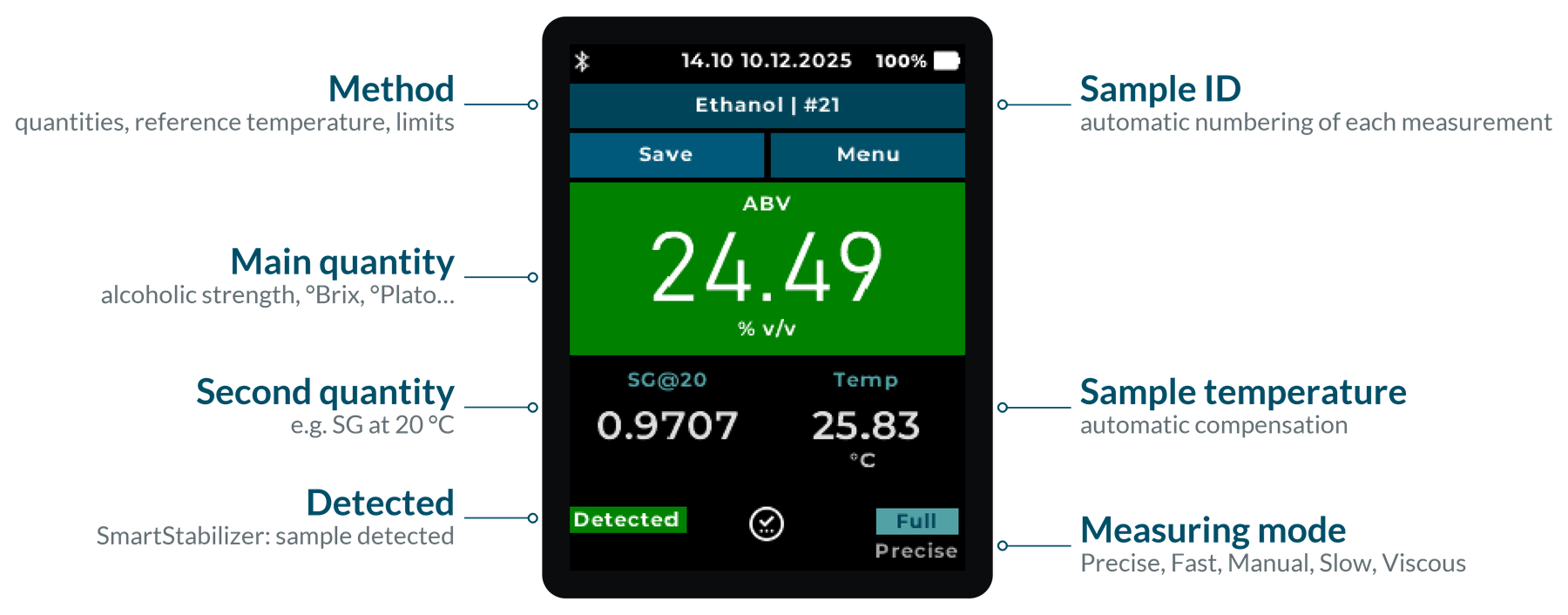
MicroDens display with the Ethanol method: alcoholic strength in % v/v and specific gravity (SG) at 20 °C.
Ethanol method
Alcohol by volume (ABV) and SG
The Ethanol method calculates alcohol by volume at 20 °C and specific gravity (SG) from the sample density, according to the OIML R 22 tables. On water-alcohol mixtures, such as unaged spirits without added sugar, the measurement is direct on the sample. Liqueurs, bitters and aged spirits are measured after distillation.
- ABV — alcohol by volume, % v/v
- ABW — alcohol by weight, % w/w, in a user method
- US Proof and % vol at 60 °F — with the Spirits US method
Spirits US method
US Proof and % vol at 60 °F
The Spirits US method expresses alcohol content on the US basis. US Proof, % vol at 60 °F and SG 60/60 °F are calculated on the basis of the AOAC/TTB tables (27 CFR 30.66, Table 6), starting from the measured density. Water-alcohol mixtures are measured directly; for liqueurs and aged spirits, the true strength is determined on the distillate.
Calculated values
- US Proof — twice the % vol at 60 °F (0…200), to one decimal place
- % vol at 60 °F — alcohol by volume referred to 60 °F, to two decimal places
- SG 60/60 °F — specific gravity referred to water at 60 °F
- Intended use — quality control and label verification of alcoholic strength (US tolerance ±0.3 % vol)
- Canada — alcoholic strength referred to 20 °C, with the Ethanol method
- Temperature unit — °F, selectable for use in the United States
Wine DryExt method
Dry extract in two readings
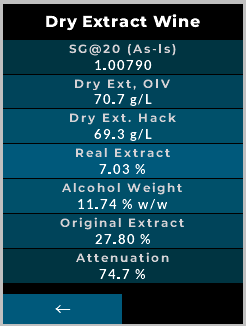
The Wine DryExt method also applies to bitters, liqueurs and distilled spirits. The first reading is taken on the sample as is, the second on the distillate obtained with SDEE. From the two densities the instrument calculates dry extract, real extract and attenuation.
- Dry extract (g/L)
- Real extract
- Attenuation (%)
- ABV from the distillate
Liqueurs, bitters and syrups
Finished-product density and ABV on the distillate
In liqueurs and bitters the density at 20 °C depends on alcohol, sugars and the substances extracted from the botanicals. MicroDens measures the density of the finished product to check uniformity between batches; alcohol by volume is determined on the distillate of the sample with the Ethanol method, dry extract with the Wine DryExt method.
For the sugar syrups used in production, the Sugar Brix and Sucrose methods calculate concentration from density. The instrument accepts samples with viscosity up to 50 mPa·s; the measurement is calibrated up to 5 mPa·s.
Distillation and ABV measurement
In products containing sugars or extracted substances, such as liqueurs, bitters and aged spirits, distillation separates the alcohol from the rest of the matrix before the density measurement.
- Sample distillationA known volume of sample is distilled and the alcoholic fraction is collected.
- Making up to volumeThe distillate is made up to the initial volume with deionized water.
- Density measurementMicroDens measures the density of the distillate and refers it to 20 °C. With SmartStabilizer, the display shows “Detected” when successive fillings agree.
- Alcohol content calculationThe Ethanol method calculates ABV and SG according to the OIML R 22 tables. The Spirits US method calculates US Proof and % vol at 60 °F.
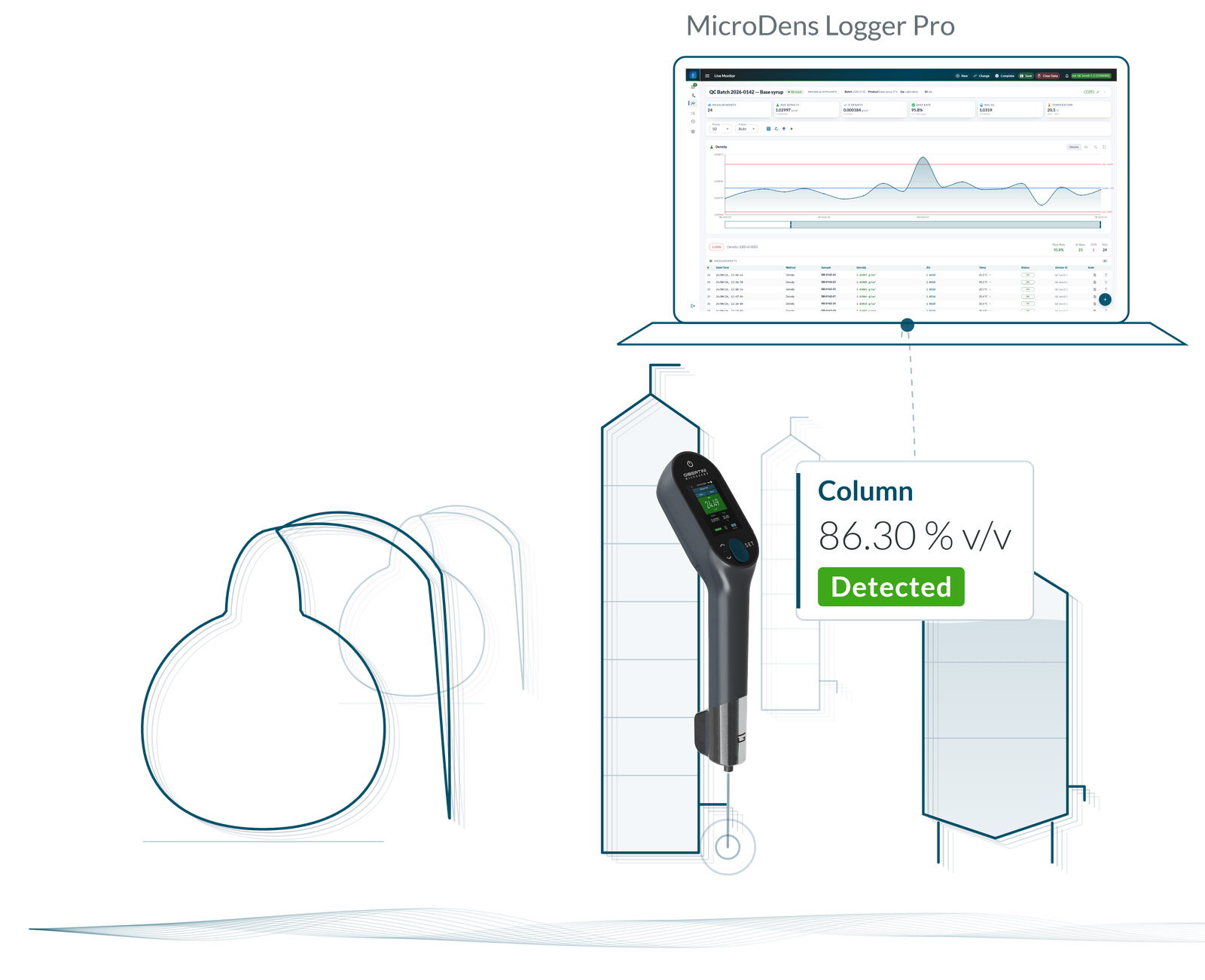
Measurement of the distillate in the distillery and transfer of the reading to MicroDens Logger Pro through the MicroDens BLE dongle.
Dry extract with Wine DryExt
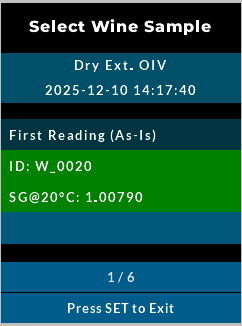
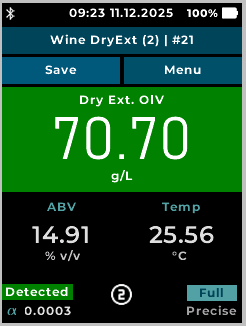
For bitters and liqueurs, and in general for products containing sugars or extracted substances, the Wine DryExt method determines the dry extract with two readings: the first on the sample as is, the second on the distillate obtained with SDEE.
- First reading: sample as isThe sample is measured as is. The instrument calculates SG@20 and stores it for the second reading.
- Distillation with SDEEThe sample is distilled with SDEE and the distillate is made up to volume with deionized water.
- Second reading: distillateThe distillate is measured. MicroDens calculates dry extract and ABV. With SmartStabilizer, the display shows “Detected” when successive fillings agree.
- ResultsDry extract, real extract, attenuation and ABV.
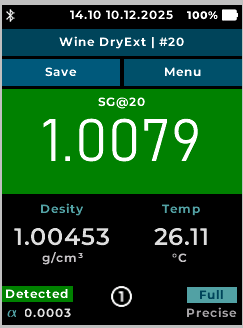
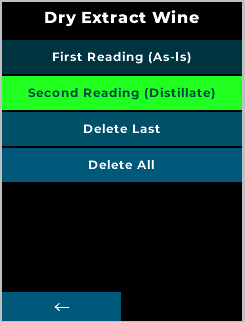
Click to enlarge
Measurement parameters
Values measured and calculated by MicroDens for spirits, bitters and liqueurs
| Distilled spirits — output values | ||
|---|---|---|
| Parameter | Method | Unit |
| Instrument measurement | ||
| Density (ρ) at 20 °C | all methods | g/cm³ |
| Specific gravity (SG) at 20 °C | Ethanol | SG |
| Alcohol content — available scales | ||
| ABV at 20 °C | Ethanol | % v/v |
| US Proof, 0…200 (1 decimal place) | Spirits US | proof |
| ABV @60F, % vol at 60 °F (2 decimal places) | Spirits US | % v/v |
| SG 60/60F | Spirits US | SG |
| ABW, alcohol by weight | user method | % w/w |
| Wine DryExt — calculated values | ||
|---|---|---|
| Parameter | Reading | Unit |
| SG@20 of the sample as is | first | SG |
| Dry extract | second | g/L |
| Dry extract, Hackbarth model | second | g/L |
| Real extract | second | % w/w |
| Attenuation | second | % |
| ABV of the distillate | second | % v/v |
| Liqueurs, bitters and syrups — output values | ||
|---|---|---|
| Parameter | Method | Unit |
| Finished product | ||
| Density (ρ) at 20 °C | all methods | g/cm³ |
| Dry extract (two readings) | ||
| Dry extract | Wine DryExt | g/L |
| Real extract | Wine DryExt | % w/w |
| Attenuation | Wine DryExt | % |
| Distillate of the sample | ||
| ABV at 20 °C | Ethanol | % v/v |
| US Proof, ABV @60F and SG 60/60F | Spirits US | proof, % v/v, SG |
| Sugar syrups | ||
| Degrees Brix | Sugar Brix | °Brix |
| Sucrose | Sucrose | % |
| Metrological performance | ||
|---|---|---|
| Parameter | Accuracy | Resolution |
| Density (ρ), 0.600…1.200 g/cm³ | ±0.0001 g/cm³ | 0.00001 g/cm³ |
| ABV, 0…100 % v/v | 0.1 % v/v | — |
| ABV, repeatability (s.d.) | 0.05 % v/v | |
| Sample temperature, -10…+60 °C | ±0.1 °C | — |
| Sample viscosity | up to 50 mPa·s; calibrated up to 5 mPa·s | |
| Sample volume | 1 mL per filling; 3 to 5 fillings for the “Detected” result, depending on the liquid | |
Reference standards and tables
Alcoholometric tables used by MicroDens to calculate alcohol content, references for the dry extract calculation, and references for the spirit drinks industry.
| Calculation references | |
|---|---|
| Measuring principle | Electronic oscillating-tube densimetry, according to the principle of method B of OIV-MA-AS2-01 and OIV-MA-AS312-01 |
| OIML R 22 | International alcoholometric tables. MicroDens uses them to calculate alcohol by volume and alcohol by weight from the density at 20 °C. |
| OIV-MA-BS-01 and Regulation (EC) No 2870/2000 | OIV methods for spirit drinks. Together with Regulation (EC) No 2870/2000, it requires the OIML R 22 tables for the correspondence between density and alcoholic strength. |
| OIV-MA-AS312-02 | OIV alcoholic strength tables. Table I is used to cross-check the alcoholometric tables at 20 °C. |
| OIV-MA-AS2-03B | OIV method for wine, reference for the dry extract calculation in the Wine DryExt method. The method also applies to bitters and liqueurs with the same calculation. |
| Hackbarth | Thermodynamic model for solutions of water, ethanol and extract, from which the Wine DryExt method derives a second dry extract value. |
| 27 CFR 30.66 (TTB), Table 6 | Basis for the calculation of US Proof and % vol at 60 °F, shared with the AOAC tables |
| Tanaka et al. (2001), Metrologia 38 | Water density |
Related instruments
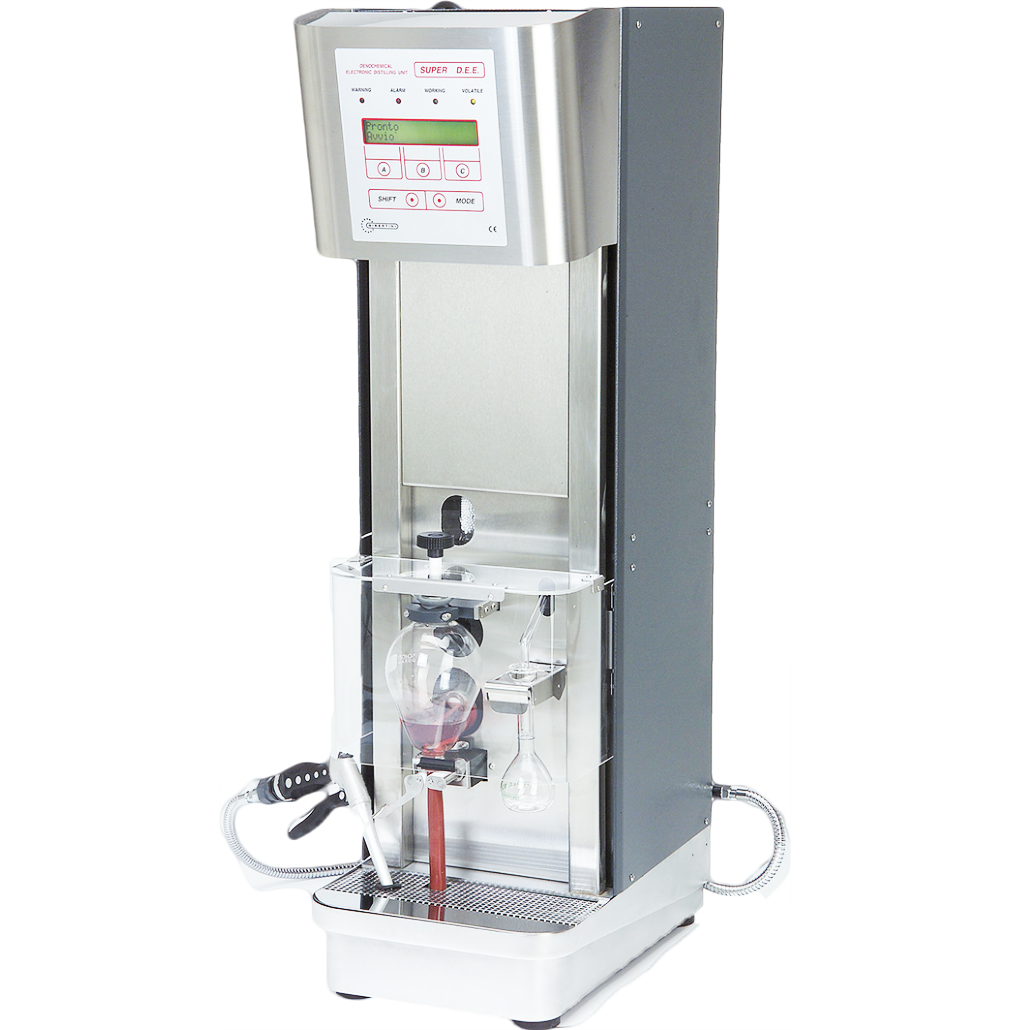
Other Gibertini instruments for the distillery laboratory
Information and quotations
For a demonstration or a quotation, contact Gibertini.
Request a demo Discover MicroDens