

Beer
quality control
Beer DryExt, BeerQuick and QuickPlato methods for calculating
original gravity (OG), apparent and real extract, ABV and attenuation.
Applications
Use of MicroDens in the brewery, from wort to finished product
Wort control
Measurement of the original gravity (OG) before fermentation, for consistency from one brew to the next.
Fermentation monitoring
Extract and attenuation trend in the fermenter, to decide when to transfer.
Finished product control
Determination of alcohol and real extract before packaging, for the alcohol content stated on the label.
Research and development
Development of new beers by comparing extract parameters across trials.
Measurement methods
Extract, alcohol and fermentation progress.
Distillation and direct measurement
In unaltered beer, the extract affects density, so a density measurement alone cannot determine the alcohol content. The Beer DryExt method therefore includes distillation of the sample, with calculations per ASBC and MEBAK; BeerQuick estimates the same parameters without distillation and is intended for process control.
Beer DryExt
Method with distillation
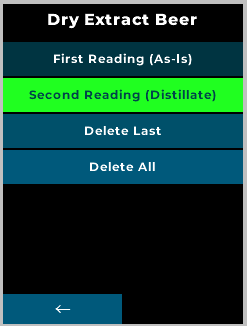
Determines the real extract and alcohol content of beer with two readings, on the unaltered beer and on the distillate. Distillation separates the alcohol from the extract.
- First Reading (As-Is) — measurement of the beer (SG@20)
- Second Reading (Distillate) — measurement of the distillate
- Calculation of OG, apparent extract and real extract (RE)
- Alcohol by volume (ABV) and by weight (ABW) from the distillate
- Calculations per ASBC Beer-4, MEBAK Band II and EBC Analytica
BeerQuick
Estimate without distillation
Follows fermentation without distillation. From the wort reading and the subsequent readings it estimates alcohol, real extract and attenuation, for frequent checks in production.
- Original Reading (Wort) — stores the original gravity (OG) in °P and SG@20
- Fermentation Reading — apparent extract during and at the end of fermentation
- Estimated ABV and real extract
- Apparent (ADF) and real (RDF) degree of fermentation
- Density difference (dSG) and alcohol by weight (ABW)
- Reference temperature: 20 °C
QuickPlato
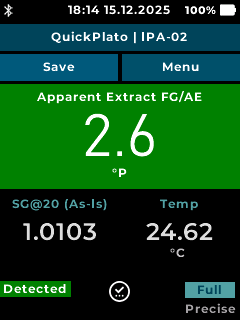
°Plato and SG@20 in one reading
QuickPlato measures a single sample and shows the extract in °Plato and SG@20 on the display. °Plato is the scale in everyday use in the brewery for worts and beers, the same as traditional saccharometers. The method requires no original reading and no OG storage.
- °Plato — main result
- SG@20 °C — relative density
- ±0.0001 g/cm³ — density accuracy
- Sugar Plato · Sugar Brix — other instrument methods
- Wort · fermenting beer · finished beer
Beer DryExt workflow
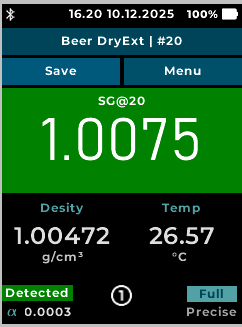
Beer DryExt determines the real extract with two readings, one on the unaltered beer and one on the distillate, following the scheme of the ASBC and MEBAK methods.
- First Reading (As-Is)The unaltered beer is measured; MicroDens calculates SG@20 °C and stores it.
- DistillationThe beer sample is distilled and the distillate is brought back to its original volume with deionized water.
- Second Reading (Distillate)The distillate is measured; MicroDens calculates real extract and alcohol.
- ResultsThe display shows OG, apparent extract, real extract, ABW and real degree of fermentation.
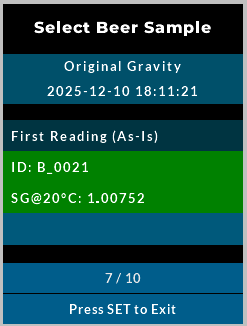
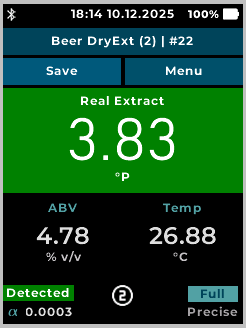
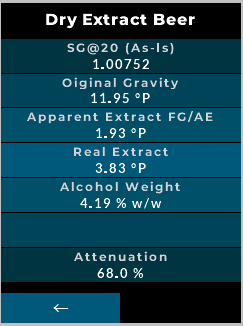
Click to enlarge
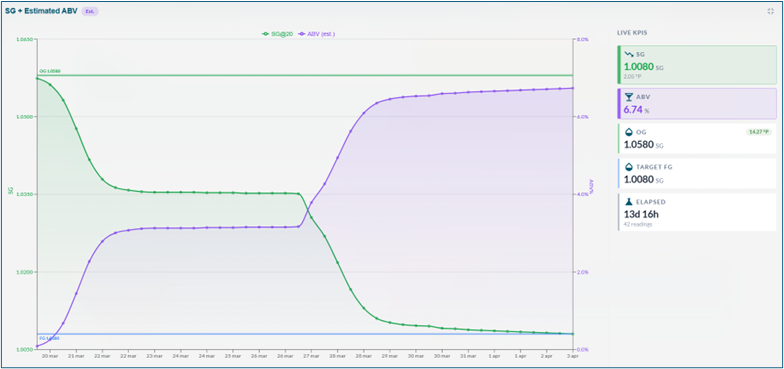
MicroDens Logger Pro, Fermentation module
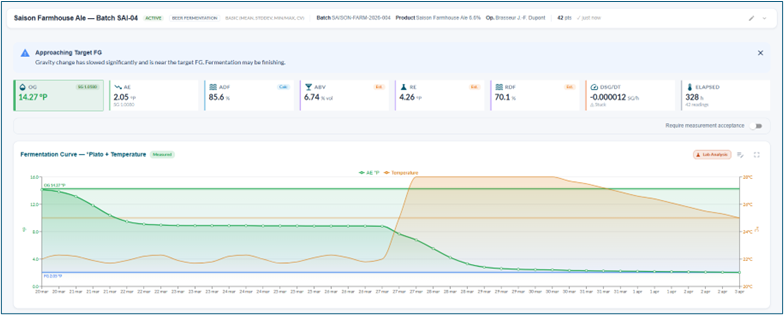
MicroDens Logger Pro, BeerQuick fermentation
BeerQuick workflow
BeerQuick follows fermentation without distillation. The wort reading sets the original gravity, and each subsequent reading of the fermenting beer updates the estimates.
- Original Reading (Wort)The wort is measured before fermentation; the instrument stores the original gravity (OG) as the reference.
- FermentationDuring fermentation, intermediate readings record its progress.
- Fermentation ReadingThe fermenting or finished beer is measured and the reference wort sample is selected.
- Estimated resultsThe display shows estimated ABV, apparent and real degree of fermentation (ADF, RDF) and density difference (dSG).
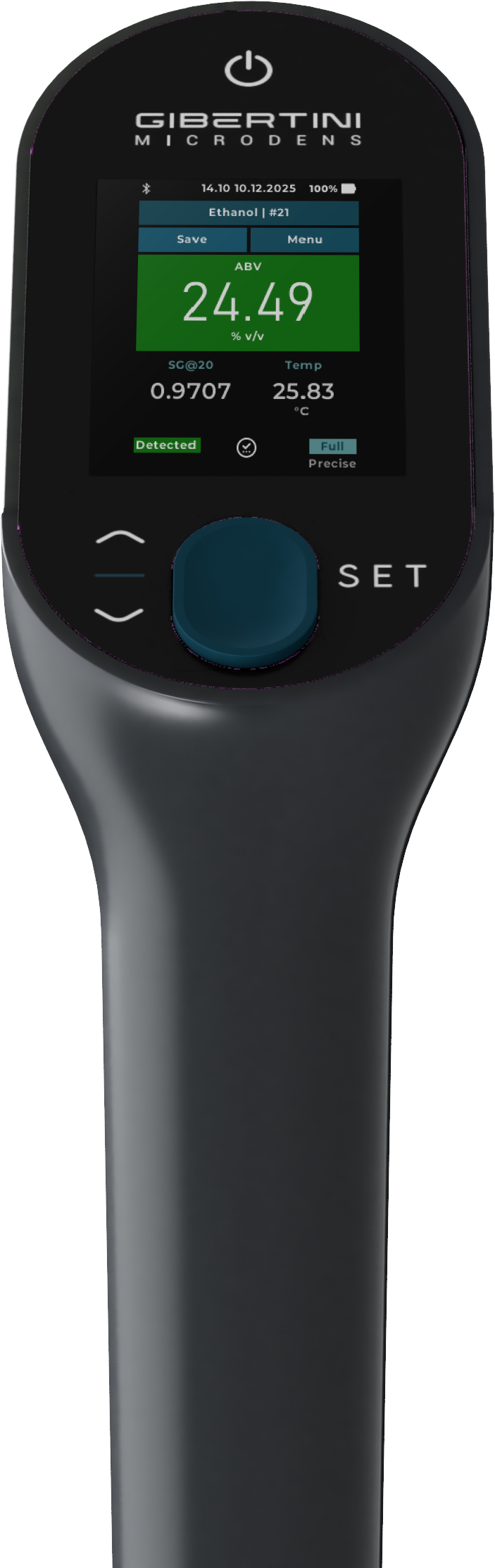
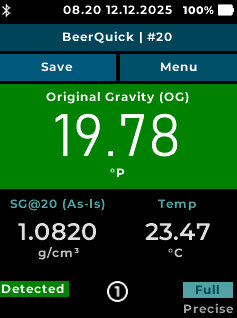
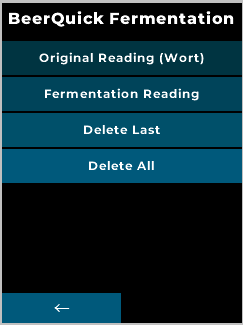
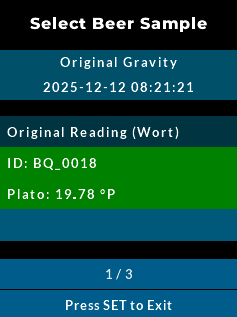
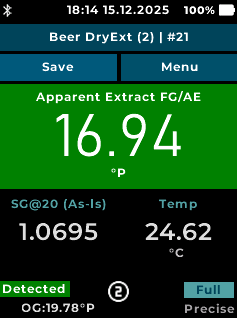
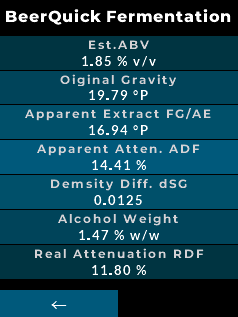
Click to enlarge
PC software
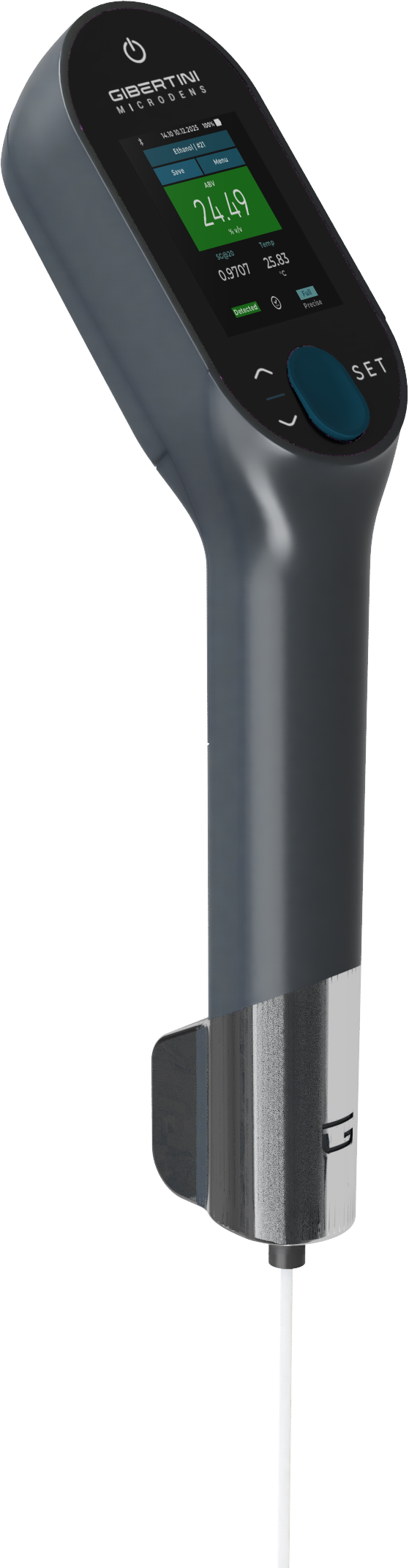
MicroDens runs the methods and shows the results without a PC. With the MicroDens BLE dongle, measurements are transferred via Bluetooth to MicroDens Data Logger, free of charge, or to MicroDens Logger Pro.
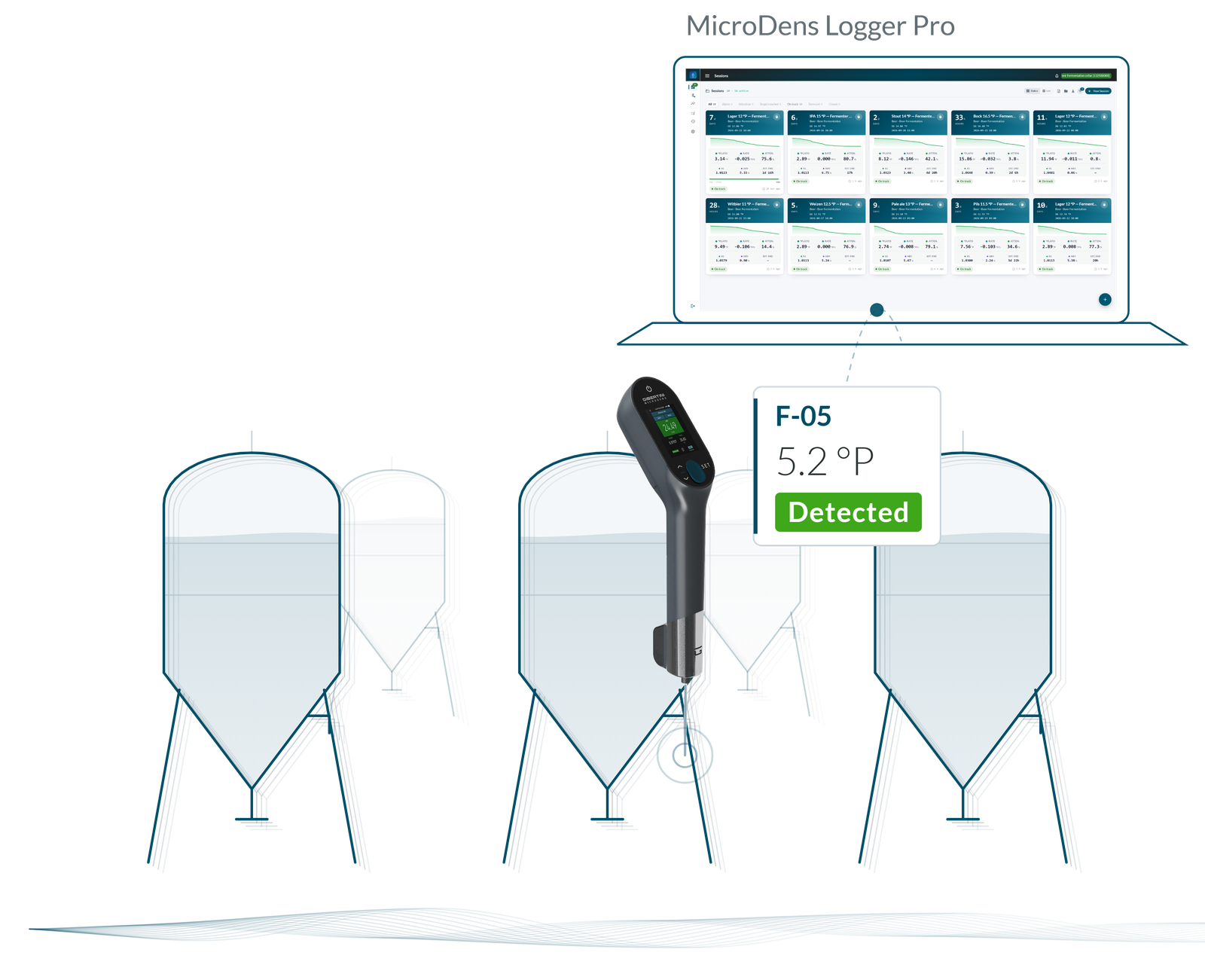
Measurement at the fermenter and transfer of the reading to MicroDens Logger Pro through the MicroDens BLE dongle.
Instrument only
LEVEL 1 — INSTRUMENT
Beer DryExt and BeerQuick guide the operator through the two readings on the touch screen. Results appear on the instrument, with no PC or connection.
- Beer DryExt and BeerQuick guided on the 2.8" color touch screen
- OG, apparent and real extract, ABV and attenuation on the display
- First reading stored on the instrument for the second
- Memory for 2000 measurements
+ MicroDens Data Logger
LEVEL 2 — DATA COLLECTION
With the MicroDens BLE dongle, it transfers each measurement to an Excel sheet as soon as it is saved on the instrument, and also the entire memory when it is sent in bulk from the instrument. The program is free.
- Reception of each measurement confirmed with the Save key
- One Excel row per measurement
- Bulk transfer of the entire instrument memory
- No manual transcription of values
+ MicroDens Logger Pro
LEVEL 3 — FERMENTATION
Every fermenter followed in real time. Each BeerQuick reading adds a point to the fermenter curve and updates extract in °Plato, attenuation, phase and status. A function of the add-on Fermentation module (wine and beer).
- °Plato and temperature curve, with the lag, active fermentation, slowdown and end phases
- Each reading assigned to the fermenter with the same OG
- Batch comparison: up to five batches besides the current one
- Final gravity (FG) projection and export to Excel and PDF
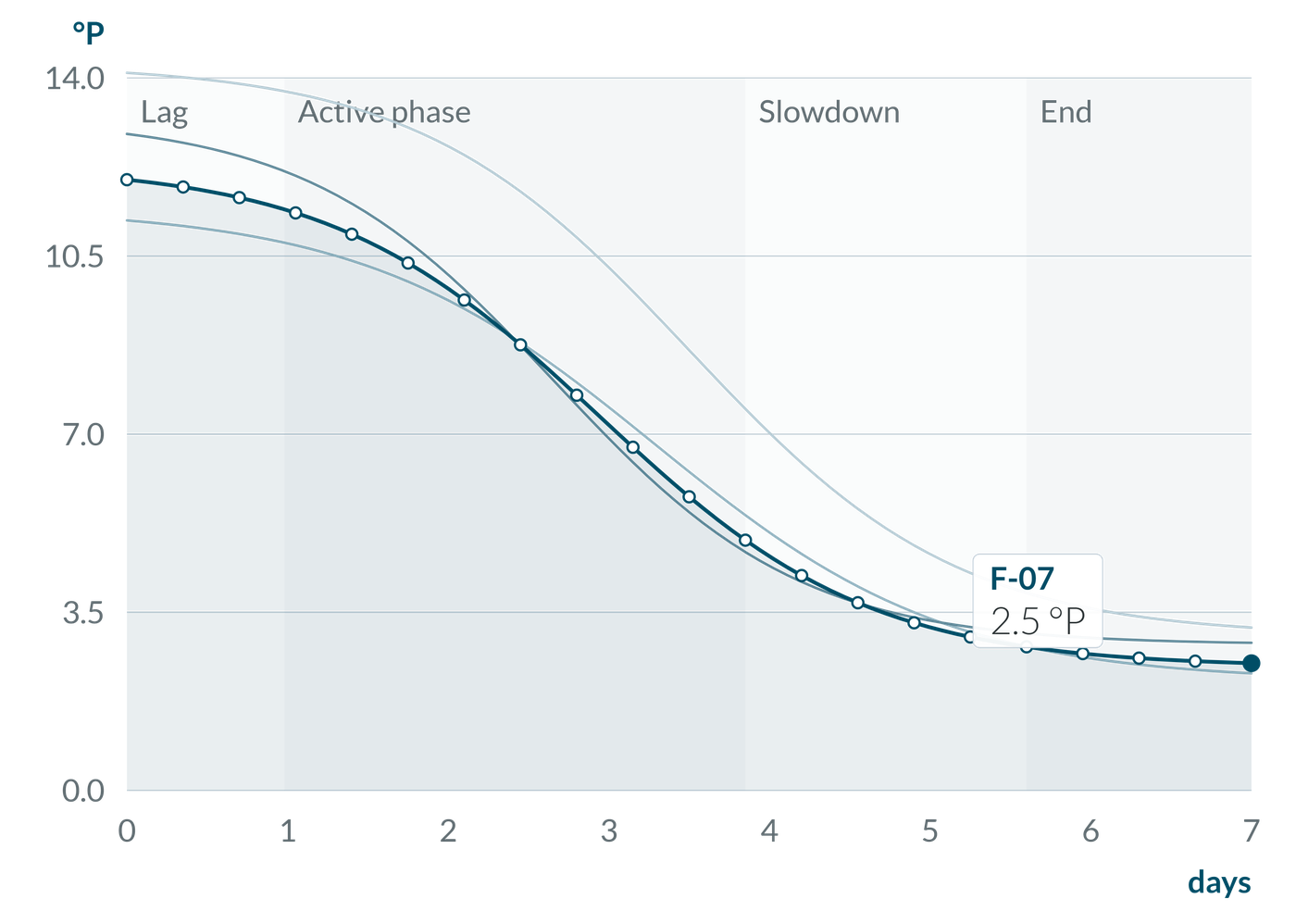
Extract curve in the Fermentation module of MicroDens Logger Pro, with the fermentation phases and batch comparison.
Screenshot of MicroDens Logger Pro, Fermentation module
MicroDens Data Logger and MicroDens Logger Pro receive the measurements through the dongle plugged into a USB port of the PC.
Download the softwareCalculated parameters
Quantities calculated by each method, with example values
| Beer DryExt — calculated parameters (example) | |
|---|---|
| SG@20 (unaltered beer) | 1.00752 SG |
| Original gravity (OG) | 11.95 °P |
| Apparent extract (FG/AE) | 1.93 °P |
| Real extract (RE) | 3.83 °P |
| Alcohol by weight (ABW) | 4.19 % w/w |
| Real degree of fermentation (RDF) | 68.0 % |
| BeerQuick — calculated parameters (example) | |
|---|---|
| Estimated ABV | 2.91 % v/v |
| Original gravity (OG) | 10.01 °P |
| Apparent extract (FG/AE) | 4.62 °P |
| Apparent degree of fermentation (ADF) | 53.85 % |
| Density difference (dSG) | 0.0219 SG |
| Alcohol by weight (ABW) | 2.31 % w/w |
| Real degree of fermentation (RDF) | 44.11 % |
| QuickPlato — calculated parameters (example) | |
|---|---|
| °Plato (from SG@20 °C) | 11.43 °P |
| SG@20 °C | 1.04600 SG |
| Technical data — accuracy and resolution | ||
|---|---|---|
| Parameter | Accuracy | Resolution |
| Density (ρ) | ±0.0001 g/cm³ | 0.00001 g/cm³ |
| Alcohol by volume (ABV) | ±0.1 % v/v | 0.01 % v/v |
| Sample temperature | ±0.1 °C | 0.01 °C |
| Sample volume | 1 mL per filling; 3 to 5 fillings for the “Detected” result, depending on the liquid | |
Reference standards and tables
The beer methods calculate their parameters according to the standards and tables of brewing analysis.
ASBC Beer-4
American Society of Brewing Chemists, Methods of Analysis. Calculation reference for Beer DryExt and BeerQuick; °Plato is derived with the ASBC polynomial.
MEBAK Band II
Mitteleuropäische Brautechnische Analysenkommission, Brautechnische Analysenmethoden. Calculation reference for Beer DryExt and BeerQuick.
EBC Analytica
European Brewery Convention, Analytica. Calculation reference for Beer DryExt.
OIML R 22
International alcoholometric tables. Calculation reference for alcohol by volume and by weight (ABV, ABW).
Information and quotes
For a demonstration or a quote, contact Gibertini.
Request a demo Discover MicroDens