

Quality Control
Milk
Specific gravity of raw milk at 15 °C and added water estimate.
The Milk method adopts the Quevenne lactometer as its reference.
Milk Method
The Milk method derives the specific gravity of milk at 15 °C and an estimate of added water from the density of the sample. The calculation is performed on the instrument, and the result appears on the display together with the method limits.
SG at 15 °C
Specific gravity
The relative density of milk (SG, specific gravity) is referred to 15 °C, the temperature of the Quevenne lactometer, with a linear temperature correction.
- Alpha coefficient of 0.0002 g/cm³ per °C, editable in the method
- Samples measured at different temperatures, comparable with each other
- Method limits: SG from 1.029 to 1.034
- Preset limits for normal milk
The value can be compared directly with lactometer readings at 15 °C.
Water %
Added water
The added water estimate is derived from the difference between the specific gravity of the sample and that of a reference pure milk, 1.0320 g/cm³ at 15 °C.
- Testing of raw milk at intake
- Indication of possible watering
- Flag above 15 % added water
- Selection of samples for confirmatory analysis
Each percentage point of added water lowers the density by 0.0005 g/cm³.
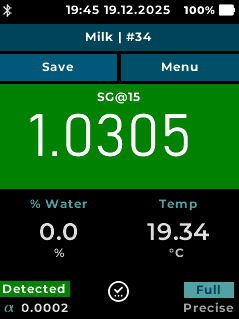
Milk within limits
SG at 15 °C between 1.029 and 1.034
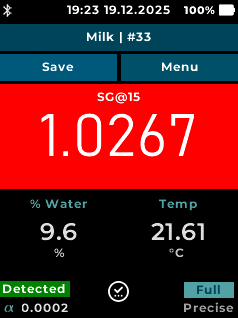
Milk out of limits
Value flagged on a red background
Milk method features
- Direct measurement — sample drawn into the cell through the filling tube
- Calculation on the instrument — SG at 15 °C and added water
- Temperature correction — referred to 15 °C
- QC limits — red background when out of tolerance
- Use — intake and in-process control
- Recording — memory of 2000 measurements with sample ID
Measuring Principle
MEMS measuring cell with an oscillating tube, integrated temperature sensor and calculation of specific gravity at 15 °C. Inside the MicroDens sensor, the liquid sets a very thin tube vibrating: its density changes the vibration, and MicroDens measures it.
Specific gravity at 15 °C
Milk method
The method measures the density of the sample and refers it to 15 °C as specific gravity (SG), with linear temperature correction. The preset limits, from 1.029 to 1.034, are those of normal milk.
- Temperature correction, editable alpha coefficient
- Check of SG limits at 15 °C
- Reference: Quevenne lactometer
- Sample ID and memory of 2000 measurements
Added water
Watering estimate
The method calculates the percentage of added water from the difference between the specific gravity of the sample at 15 °C and that of a reference pure milk. Above 15 %, the instrument flags the value as out of limits.
- Added water in %
- Reference pure milk: 1.0320 g/cm³ at 15 °C
- Change of 0.0005 g/cm³ per 1 % of water
- Flag above 15 %
Salting brine
NaCl method
On the same instrument, the NaCl method calculates the sodium chloride concentration of the brine from the density and temperature of the sample.
- Concentration in % w/w, from 0 to 26 %
- Density, concentration and temperature tables
- Relative density (SG) of the sample
Applications
MicroDens in dairies, collection centers and testing laboratories

Raw milk at intake
Specific gravity at 15 °C and added water on samples from milk deliveries.
Collection centers and tanker trucks
Battery-powered portable instrument, with 10 hours of continuous use.
Salting brine
Sodium chloride concentration with the NaCl method, from 0 to 26 % w/w.
Data recording
Measurements in memory are exported to Excel with the free MicroDens programs.
Instrument and PC Software
MicroDens works on its own. With the MicroDens BLE dongle, measurements are transferred to the PC: to an Excel sheet with MicroDens Data Logger, or to the sessions of MicroDens Logger Pro.
Standalone use
INSTRUMENT
The Milk method guides the operator on the touch display. Results appear on the instrument, with no PC and no connections.
- SG at 15 °C and added water on the instrument
- SG limits flagged on a red background
- Memory of 2000 measurements with sample ID
+ MicroDens Data Logger
DATA COLLECTION
Free software. With the MicroDens BLE dongle, it transfers each measurement to an Excel sheet as soon as it is saved on the instrument; with bulk transfer started from the instrument, it also transfers the entire memory.
- Measurement received with the Save key on the instrument
- Bulk transfer of the memory, started from the instrument
- No manual transcription of measurements
- MicroDens USB Extractor, free: the entire memory to Excel over the USB cable
+ MicroDens Logger Pro
MILK QUALITY CONTROL
Paid software, with price on request and a 30-day free trial. The Milk Quality Control method collects measurements in sessions.
- Dedicated added water panel
- Measurements acquired with the MicroDens Milk method
- Sessions exportable to Excel, PDF and CSV
Parameters and Technical Data
Preset values of the Milk and NaCl methods and instrument specifications
| Milk Method — Calculated parameters | |
|---|---|
| Specific gravity at 15 °C (SG) | SG |
| Added water | % |
| Parameter | Value | Note |
|---|---|---|
| Reference temperature | 15 °C | Quevenne lactometer |
| SG limits at 15 °C | 1.029 – 1.034 | Normal milk |
| Reference pure milk | 1.0320 g/cm³ | Density at 15 °C |
| Added water | 0.0005 g/cm³ per 1 % | Flag above 15 % |
| Alpha coefficient | 0.0002 g/cm³ per °C | Editable in the method |
| NaCl Method — Calculated parameters | |
|---|---|
| Sodium chloride, from 0 to 26 % | % w/w |
| Relative density | SG |
| Parameter | Accuracy | Resolution |
|---|---|---|
| Density (ρ), from 0.600 to 1.200 g/cm³ | ±0.0001 g/cm³ | 0.00001 g/cm³ |
| Sample temperature, from -10 to +60 °C | ±0.1 °C | 0.01 °C |
| Viscosity | Up to 50 mPa·s, calibrated measurement up to 5 mPa·s | |
| Sample volume | 1 mL per filling; 3 to 5 fillings for the “Detected” result, depending on the liquid | |
| Memory | 2000 measurements | |
Calculation References
The calculation models of the Milk and NaCl methods come from the technical literature and are described in the instrument documentation.
Quevenne lactometer
The Milk method refers specific gravity to 15 °C, the reference temperature of the Quevenne lactometer: values remain comparable with traditional readings.
Temperature correction
The measured density is referred to 15 °C with a linear correction; the alpha coefficient, 0.0002 g/cm³ per °C, can be changed in the method settings.
Sodium chloride
The NaCl method calculates brine concentration from density, concentration and temperature tables taken from Perry's Chemical Engineers' Handbook, from 0 to 26 % w/w.
Recording of measurements
Each measurement is stored in the instrument memory with date, time and sample ID, for the recording of intake checks.
Information and Quotations
For a demonstration or a quotation, please contact Gibertini.
Request a demo Discover MicroDens